Paul GAVARNI (French, Paris 1804–1866 Neuilly-Auteuil-Passy)
Paul GAVARNI was a French illustrator, lithographer, and painter known for his refined wit, keen cultural insight, and vivid portrayal of the society of his era. While his work is highly engaging, it does not possess the same depth and intensity as that of his great contemporary, Honoré Daumier.
He took his pen name Paul Gavarni from Gavarnie in Luz-Saint-Sauveur where he had taken a journey into the Pyrenees.
Around 1831, Gavarni started publishing illustrations depicting scenes of everyday contemporary life. His work received praise from writers like Honoré de Balzac, which helped him gain popularity. In 1833, he launched the Journal of High Society, but it failed after 18 issues, ultimately leading to his imprisonment for debt in 1835, where he remained for nearly a year. Between 1839 and 1846, he published his renowned series Les Lorettes, Les Débardeurs, and Les Fourberies de femmes (“The Deceit of Women”). Around 1845, following the death of his mother and the collapse of his marriage, his artistic style evolved, becoming more profound, serious, and refined.
With a deeper understanding of human nature, Gavarni’s works from this period ironically highlight the grotesque aspects of family life and reflect a distinctly bitter philosophy. In 1847, he traveled to London, where he spent his time observing the struggles of the poor and creating some of his most powerful pieces. After returning to Paris, he focused more on watercolor painting, and in 1851, he met the Goncourt brothers, longtime admirers of his work. Their book, Gavarni: The Man and the Work, was published in 1873. Gavarni also returned to lithography, contributing to the periodical Paris with one of his major series, Masques et visages (1852–53). At the time of his death, he was engaged in etching, lithography, and experimenting with a new technique—electric engraving.
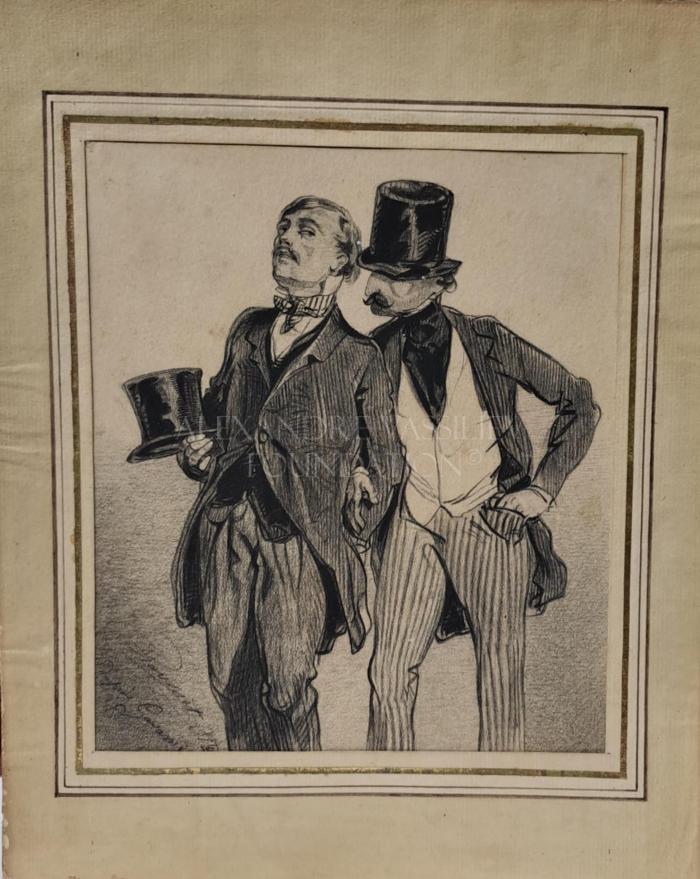
Related Object: Double portrait of two men