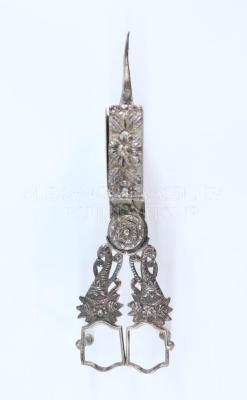


Snuffers
Applied Arts
Inventory number
2021.6.21.5.AA.OT.C1830.FRDescription
Table candle wick trimmer in silver and steel with blades to cut the wick and a small box on the side of the blades to catch the hot wick. The handle is openwork with a design of cornucopias full with flowers, and daisy flower from both sides.Snuffers were first invented to cut off and retain the burned wicks of candles when the wax around them had melted. Snuffers were often made to match candlesticks and could be finely decorated with heraldry or engraved decoration, and were often supplied with a stand or a tray to put the snuffers in. When the candle wick didn't burn down at the same time as the candle it could droop over onto the side of the candle and risked putting the candle out, or much worse, causing fires.
They are first recorded in the 15th century and numerous patents for snuffers are known from the middle of the 18th century, regularly reappearing with improvements until the self-trimming plaited wick was invented in 1825 by Joseph CAMBACERES. It curls over into the hottest part of the flame and burns away making it unnecessary to trim the wick.
The use of snuffers will still continue till the middle of the 19th century, starting to slightly dissapear.
Materials
SteelSilver
Origin
circa 1830 FranceDimensions
Width : 4.5 cmLength : 16 cm
Height : 4 cm