Wedgwood (British, founded 1759)
Wedgwood, by its full name "Josiah Wedgwood and Sons", is a British pottery, earthenware and porcelain factory founded in May 1759, at the very beginning of the Industrial Revolution in the United Kingdom, by Josiah WEDGWOOD and his son Thomas WEDGWOOD.
Josiah WEDGWOOD achieved rapid success and remained one of Staffordshire's largest pottery makers, exporting across Europe to Russia and the Americas.
In 1769, WEDGWOOD founded near Stoke-on-Trent, with the merchant and man of letters Thomas BENTLEY, a large factory with well-organized buildings and ultra-modern workshops. The West was then fascinated by the archaeological discoveries of Greek and Roman antiquity. He thus named his factory Etruria.
Following the development of a black and very hard sandstone, unique because tinted in the mass, the "Black Basalt" (trade name unrelated to the volcanic rock) he developed in France his most famous earthenware, called jasper paste ( or "Jasperware"). It is an earthenware with a dry body (unglazed) tinted and covered with application in low relief of white earthenware. Patterns can also be colored on a white body. These applications are inspired by antiquity.
In the midst of the European neo-classical wave, the cameos and then the decorative objects in Jasperware made the reputation of Josiah WEDGWOOD. The background of Jasperware is generally pale blue (known as "Wedgwood blue"), but other colors exist: yellow, lilac, ochre, pale green and black.
After the death of Thomas BENTLEY and Josiah WEDGWOOD, Josiah Wedgwood and Sons continues to manufacture all the classic bestsellers but the quality tends to decline. At the end of the 19th century, Etruria offered some well-received novelties, while continuing to manufacture many older styles.
After the Second World War, Etruria is abandoned for new brand new workshops.
Josiah WEDGWOOD achieved rapid success and remained one of Staffordshire's largest pottery makers, exporting across Europe to Russia and the Americas.
In 1769, WEDGWOOD founded near Stoke-on-Trent, with the merchant and man of letters Thomas BENTLEY, a large factory with well-organized buildings and ultra-modern workshops. The West was then fascinated by the archaeological discoveries of Greek and Roman antiquity. He thus named his factory Etruria.
Following the development of a black and very hard sandstone, unique because tinted in the mass, the "Black Basalt" (trade name unrelated to the volcanic rock) he developed in France his most famous earthenware, called jasper paste ( or "Jasperware"). It is an earthenware with a dry body (unglazed) tinted and covered with application in low relief of white earthenware. Patterns can also be colored on a white body. These applications are inspired by antiquity.
In the midst of the European neo-classical wave, the cameos and then the decorative objects in Jasperware made the reputation of Josiah WEDGWOOD. The background of Jasperware is generally pale blue (known as "Wedgwood blue"), but other colors exist: yellow, lilac, ochre, pale green and black.
After the death of Thomas BENTLEY and Josiah WEDGWOOD, Josiah Wedgwood and Sons continues to manufacture all the classic bestsellers but the quality tends to decline. At the end of the 19th century, Etruria offered some well-received novelties, while continuing to manufacture many older styles.
After the Second World War, Etruria is abandoned for new brand new workshops.
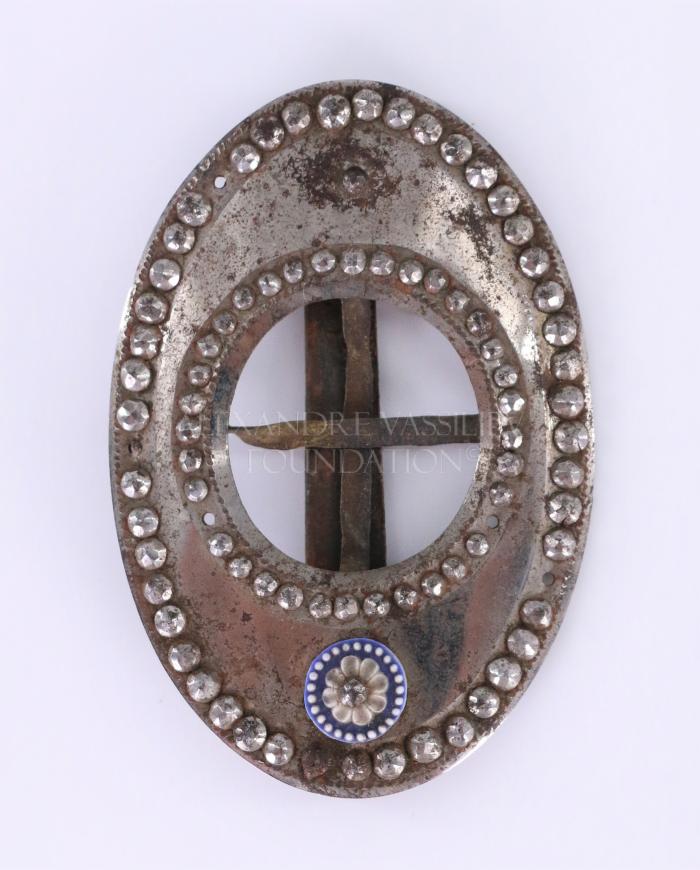
Related Object: Belt buckle